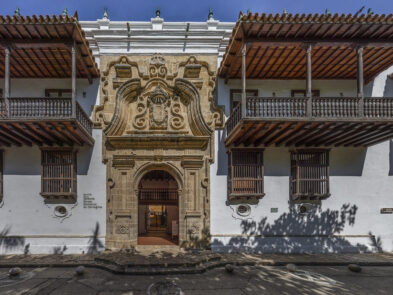
Cartagena de Indias has an international airport, Rafael Núñez International Airport, which serves as a gateway to the city for travelers.
The airport is located just 10 minutes from the historic center, where the main tourist attractions and accommodations are located, making it easy to get to your hotel or meeting place. Many airlines offer direct flights to Cartagena, including JetBlue, KLM, LATAM and Avianca, among others. Cartagena de Indias is well connected to many international hubs around the world.
These are some of the destinations that have direct connections with Cartagena de Indias.
- Miami American Airlines and Avianca
- Fort Lauderdale Jet Blue and Spirit Airlines
- New York JetBlue and Avianca Airlines
- Madrid Plus Ultra Airlines
- Amsterdam KLM Airlines
- Panama City Copa Airlines and Wingo Airlines
- Orlando Spirit Airlines
- Lima Latam Airlines
- San José Avianca Airlines
- Sao Paulo Avianca Airlines
- Santiago Avianca Airlines
- Guayaquil Avianca Airlines
In addition, Cartagena is 1.5 hours by plane from Bogota, the country’s capital, with more than 50 daily flights between the two cities.
The Heroic City, as Cartagena is known, adds to the charms of its colonial architecture, the attractions of an intense nightlife, cultural festivals and lush landscapes. The city’s beaches invite you to sightsee, relax and enjoy the refreshing breeze and the warm waters of the Caribbean Sea.
In addition, Cartagena has an excellent gastronomic offer and an important hotel and tourist infrastructure.
This fantastic destination holds the secrets of history in its walls, balconies and narrow stone paths that inspired Gabriel García Márquez, winner of the Nobel Prize for Literature in 1982.
Framed by a beautiful bay, Cartagena de Indias is one of the most beautiful and best preserved cities in the Americas; a treasure that, today, is one of the most visited tourist destinations in Colombia.
The weather in Cartagena de Indias is enviable. The city is warm and hot almost all year round. The temperature oscillates, in general, between 23 and 30º C.
It is true that throughout the year you can enjoy a very good climate in Cartagena, but the best time to visit the city is between late November and late April, because it hardly rains during that season.
Citizens of some countries need to present a tourist visa that must be processed at the Colombian embassies or consulates abroad. In the following link you can verify if you require a visa or not.
Consult the countries that require visa in cancilleria.gov.co
The official currency is the Colombian peso, abbreviated COP. The daily quotation of the peso fluctuates, however the average is approximately 4000 to 4100 COP per 1 USD.
The city has 4 important tourist areas.
- Historic Center and Getsemaní
- Modern Zone Bocagrande, Laguito and Castillogrande
- North Airport Zone
- Manga Puerto
Within each of the sectors, all distances can be covered on foot, and additionally, the city has bicycle and Segway rental establishments.
In case you wish to go to another area, we recommend taking a cab service, identified with yellow color, in which the trips have a duration of no more than fifteen minutes.
For those who wish to take an alternative type of transportation, the city has red double-decker buses, trolley buses, chivas (typical bus), and cars, in which you can take a tour of the city and its main monuments.
Currently, there are no vaccinations required to enter the country. However, Colombian authorities will require a yellow fever vaccine if you are visiting tourist sites such as the Sierra Nevada de Santa Marta National Park, Tayrona Park and the various Amazon reserves.
In order to avoid any mishaps during your trip to Colombia, it is important that you take into account some recommendations regarding health and vaccinations.
For more information, please visit the Ministry of Health and Social Protection website: minsalud.gov.co.
Get to know Cartagena de Indias,
live the magic!
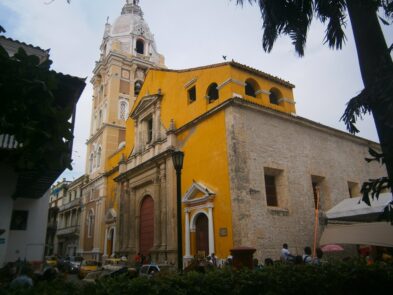
St. Catherine of Alexandria Cathedral
Like many cathedrals, this is a basilica, a church composed of 3 naves or elongated spaces separated by columns in the direction of the altar. It is a masterpiece of the master builder Simón González, who designed it on the model of some basilicas in Andalusia and the Canary Islands. Construction began in 1577, although it was only finished 84 years later after overcoming incredible adversities.
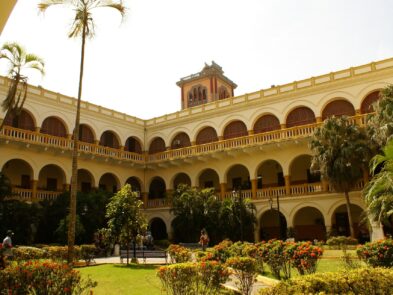
Cloister
San Agustín
It has 150 years of history. It housed the Barefoot Augustinian Fathers. At the present time it is the main seat of the University of Cartagena, one of the oldest academic centers in Colombia. It was founded in 1825, has an interior patio with a garden and a Florentine style dome.
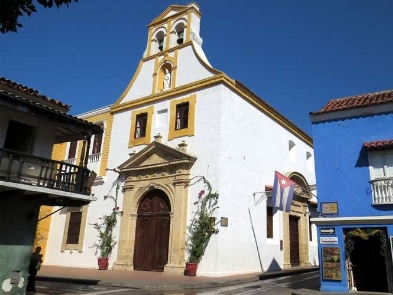
Saint Church
Toribio
It is the parish church of the colonial neighborhood of San Diego and makes an angle with the square dedicated to the hero Fernandez de Madrid. Its full name is Santo Toribio de Magrovejo and is another authentic example of religious architecture dating from 1665. Although of small proportions, it is cozy and beautiful inside, where the beautiful craftsmanship of the main altar stands out, carved in black lacquer and covered in gold leaf.
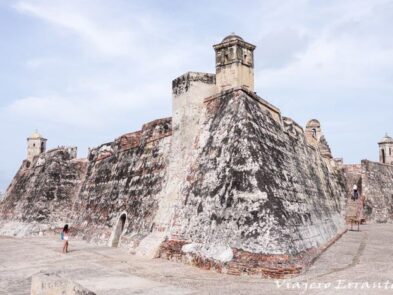
San Felipe de Barajas Castle
The Castillo San Felipe de Barajas is a military fortress in the city of Cartagena de Indias built by the Spanish during the colonial era in what is now Colombia. It was the largest of the Spanish fortresses built in the American continent. The construction began in 1536 with the name of Castillo de San Lazaro, expanded in 1657. It was built on the Hill of San Lazaro and from there dominated any attempt to invade the city, either by land or advancing through the Bay of Cartagena in the Caribbean Sea.
The Vaults
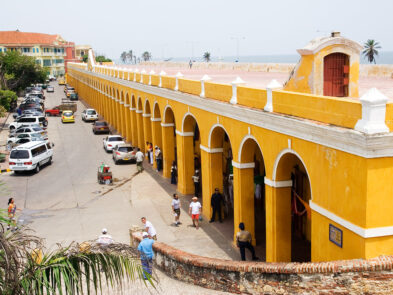
The 23 vaults are located between forts Santa Clara and Santa Catalina. They were built between 1792 and 1796 and were used as ammunition depots. During the Republican era the vaults were used as prisons. Today they are a set of warehouses where you can find a variety of handicraft stores.
Monument to Gabriel García Márquez
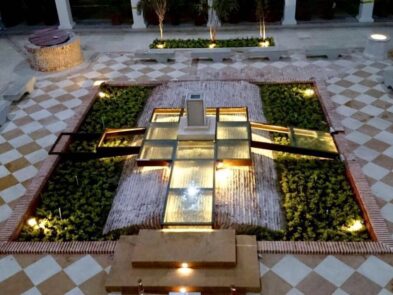
In the Cloister of La Merced, in the Historic Center of Cartagena, lie the ashes of Gabriel García Márquez, who died at the age of 87 on April 17, 2014. The ashes are contained in a floating platform on which is a bust of Gabo’s image. This monument was sculpted by British artist Katie Murray.
Adolfo Mejía Theater
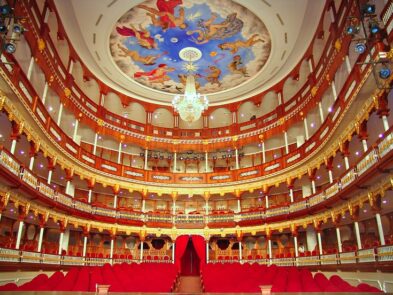
Built on the ruins of the old Church of La Merced (1625) to commemorate the Centennial of Independence in 1911. In 1998 it was restored under the direction of the Cartagena architect Alberto Samudio Trallero as a cultural center for performing arts and music. Theater built in the shape of a horseshoe with boxes and balconies divided by lattices of zero, that seem lace, originally served for ventilation. Stairs and sculptures of Italian marble with Boca curtain and ceiling beautifully created by the Cartagena artist Enrique Grau.
Clock Tower
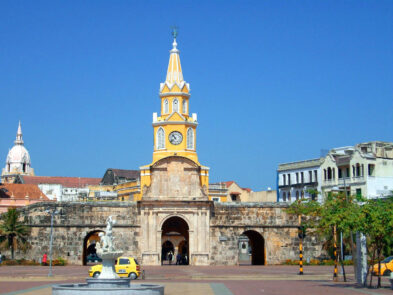
It was originally called Boca del Puente and was built as the main entrance to the walled city. The lateral arches were used as a chapel and armament room. When the enclosure of Calamari was completed around 1631, Cartagena acquired a main gate. It was the only entrance to the city proper. Against its narrow vault discharged the bridge that was already known as San Francisco, by the convent in Getsemaní design was not very significant, militarily, it was overshadowed by the vital door of the Half Moon, much more exposed and better defended. In the year 1704 the door is of three bomb-proof vaults, today all open, but where originally only the middle one served for the citizen transit. The two lateral ones were used as armament vaults and opened exclusively towards the central one, in the same way it was left the space to finally place the clock.
House Museum
Rafael Núñez
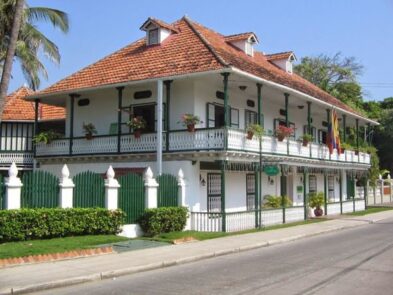
In this house lived the four times president and Colombian poet Rafael Núñez. It is a sample of Creole and Antillean style architecture in wood of the XIX century that today has its doors open to the public as a museum where personal objects and some works of his authorship are exhibited.
Museum of Modern Art
.
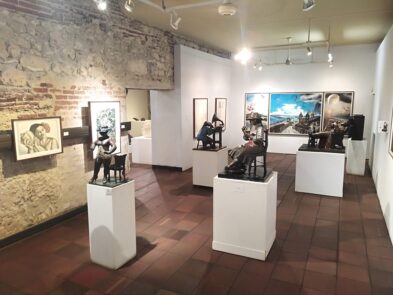
It is a cultural institution and has been in operation since 1979. It is located in the Plaza de San Pedro Claver next to the church and the convent of the same name.
It is responsible for preserving and disseminating the various manifestations of the visual arts and educate the community for their full appreciation. The site where the Museum of Modern Art of Cartagena de Indias is located consists of two buildings: one built in the second half of the seventeenth century by the Spanish Crown to house the first Customs House of the Port of Cartagena de Indias.
The second was built in the late nineteenth century as an extension of the warehouses located there.
Museum of Fortifications
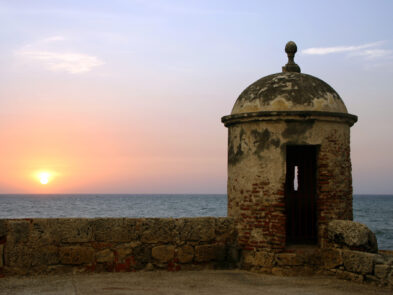
It was inaugurated in 1994. It gathers pieces of the fortified monuments of Cartagena and site museums in the Bastion of Santa Catalina and Fort of San Bernando de Bocachica, San Felipe de Barajas Castle, Battery of the Angel San Rafael, Walled Cordon, Fort of San Fernando, Fort of San José and the Historical Park Isla de Tierrabomba. This museum is located in the lower part of the bastion of Santa Catalina. It is a sample of the interior of the wall that borders the city.
Gold Museum
.
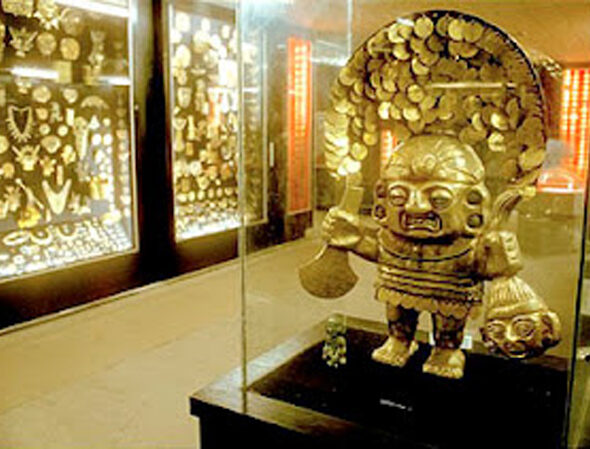
The Zenú Gold Museum is part of the Banco de la República’s network of gold museums and opened its doors to the public in 1982. Through its rooms a representative sample of the societies of the different archaeological goldsmith zones of the Colombian territory, their systems of thought, forms of social organization and adaptation to the conditions of the environment, particularly in the plains of the Colombian Caribbean, is presented.
Palace of the Inquisition and Historical Museum
In September 1610 the Inquisition was established in Cartagena de Indias to judge crimes against the Christian faith. The Court of Penalties of the Holy Office adopted as its main headquarters this palace which is one of the most elegant and characteristic constructions of the colonial era of the city. The palace is today a museum where you can visit what were once prisons and torture chambers, in addition to finding historical documents that specify the history in the historical museum installed in this same place.